
AI Dropshipping Guide for Beginners in 2026
Learn how AI dropshipping works for beginners in 2026, including product research, copy, ads, supplier checks, automation risks, and where human judgment still matters.
AI dropshipping is rising because beginners want help finding products, writing copy, creating ads, and automating repetitive work. AI can speed up research, but it cannot make weak products profitable or unreliable suppliers trustworthy. The best use of AI dropshipping is to improve decision quality, not to replace judgment.
Targets beginners searching AI dropshipping, AI product research, and dropshipping automation.
AI is strongest when it helps summarize evidence, compare options, and draft tests from real product signals.
Scrape connects AI workflows to product, competitor, ad, and supplier intelligence instead of generic prompts.
AI workflow: speed up judgment, do not replace it
AI is most useful when it compresses research and forces clearer decisions. It should not approve products without evidence.
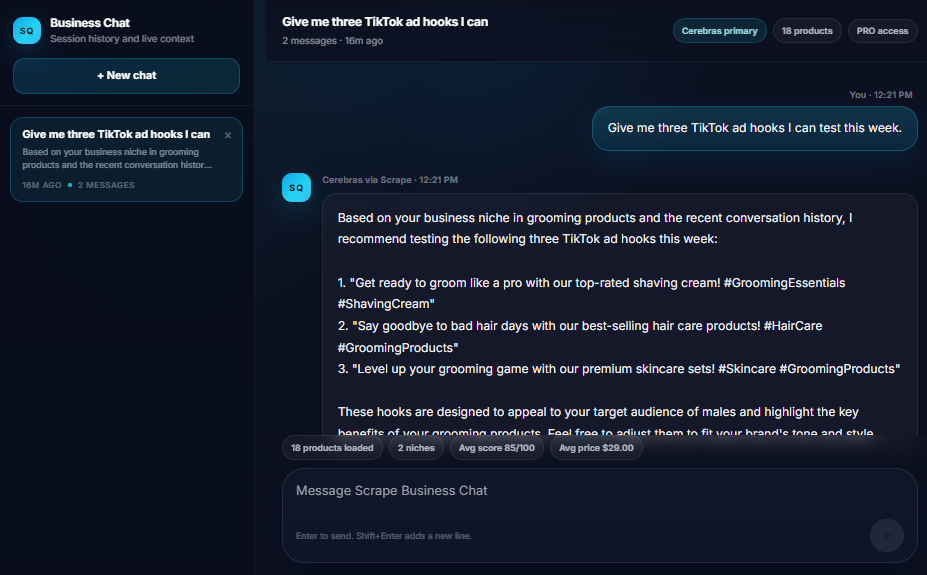
Worked example
Use AI to summarize competitor patterns, draft product-page objections, and compare supplier risk, then validate the conclusion with live product and ad data.
| Signal | Example read | Operator takeaway |
|---|---|---|
| Research summary | Compress many signals | Useful when the source data is real and current. |
| Copy support | Draft objections and benefits | Still fact-check claims and compliance. |
| Decision support | Score launch readiness | AI should explain tradeoffs, not hide them. |
| Human gate | Approve the final action | Operators own product, supplier, and ad risk. |
What AI can do in dropshipping
AI can help beginners organize product research, summarize reviews, draft product page copy, generate ad angles, compare supplier notes, and create test plans. That saves time when the inputs are real.
The trap is using AI to invent confidence. A generated product description does not prove demand. A list of trending products does not prove margin. AI is useful when it works from evidence.
- Summarize customer reviews and objections.
- Draft product descriptions and ad hooks.
- Compare product candidates against a scorecard.
- Turn research into launch, monitor, or reject decisions.
AI dropshipping product research
AI product research should start with live signals: search interest, competitor activity, marketplace movement, ad patterns, supplier cost, and buyer objections. AI can then help rank ideas and explain tradeoffs.
Scrape is useful because it gives AI workflows stronger inputs. Instead of asking a model for random winning products, beginners can review actual signals and use AI to structure the decision.
- Use AI to compare products, not blindly choose them.
- Require demand and supplier evidence before launch.
- Use generated copy as a draft, then edit for accuracy and trust.
AI automation risks beginners should avoid
Automation can create problems quickly if it publishes inaccurate claims, imports too many products, hides shipping reality, or creates generic pages that do not help customers. Beginners should keep approvals manual until the workflow is proven.
The safest approach is AI-assisted, not AI-abandoned. Let AI speed up repetitive work while you approve product choice, supplier promises, pricing, claims, and customer-facing policies.
- Do not publish health, safety, or performance claims without proof.
- Do not automate product imports without supplier checks.
- Do not let AI hide weak margin math.
- Do not use identical generic copy across products.
A beginner AI dropshipping stack
A practical AI stack starts with research, then copy, then creative, then review. Product and supplier evidence should come before generated marketing assets.
Use Scrape for the research layer, then use AI to summarize why a product passed or failed. That creates a cleaner learning loop than chasing every automated suggestion.
- Research: product, competitor, ad, and supplier signals.
- Analysis: summarize strengths, risks, and objections.
- Copy: draft product page and ad angles.
- Review: approve only what matches evidence.
Direct answer
AI Dropshipping for Beginners in is useful for dropshipping when it helps a beginner make a safer product, supplier, traffic, or store decision.
- Who it helps: beginners choosing suppliers or private-label partners.
- Decision it supports: whether a supplier is safe enough to contact, sample, negotiate with, or reject.
- Metrics to check: sample defect rate, shipping reliability, response speed, refund exposure, and landed cost.
AI Dropshipping for Beginners in for beginners
Plain-English definition
AI Dropshipping for Beginners in is a way to make a clearer dropshipping decision before you spend money on products, suppliers, ads, or store changes.
For a beginner, the goal is simple: understand what the signal means, check whether it fits your store, and avoid acting on hype before the numbers and execution path make sense. A beginner comparing two beauty suppliers should ask for delivery windows, packaging photos, refund rules, tracking quality, and sample consistency before importing products.
Beginner steps
- Start by writing the exact decision you want AI Dropshipping for Beginners in to help with.
- Check demand, margin, competition, supplier reliability, and customer trust before you launch.
- Choose one next action: test, improve, monitor, or reject the opportunity.
Beginner mistakes to avoid
- Copying a product just because another store appears to be selling it.
- Ignoring shipping, refund, support, and ad learning costs.
- Reading strategy content without turning it into a specific next step.
AI Dropshipping for Beginners in evidence checklist
This section makes the page more useful than a generic ai dropshipping for beginners in article. Use it to separate real operating evidence from keyword-level advice.
What to check
- Use the guide to define the topic, then move into examples and action thresholds.
- Check whether the advice applies to your product type, supplier model, and traffic channel.
- Finish with one decision rather than more reading.
Authority signals to build
- Primary proof: sample defect rate, shipping reliability, response speed, refund exposure, and landed cost.
- Authority asset to add over time: supplier vetting templates, sample scorecards, and sourcing checklists.
- Internal proof: link this page to related product research, supplier, ad, and store optimization pages.
Decision system for operators
Use this section when the page starts influencing real product research, supplier selection, ad testing, store positioning, or channel expansion. The goal is to protect judgment while still moving quickly.
What to verify before acting
- The page's core claim matches live product, competitor, supplier, or channel evidence.
- The economics still work after fees, refunds, shipping, support, and ad learning costs.
- The decision is clear: whether a supplier is safe enough to contact, sample, negotiate with, or reject.
- The team can execute the next step this week without creating hidden operational debt.
What to ignore
- One-off viral examples with no repeatable buyer problem.
- Supplier promises that do not match delivery, tracking, packaging, or return reality.
- Metrics that look exciting but do not change a launch, pricing, or scaling decision.
What Scrape adds
- Live product and market context so research is connected to movement, not stale lists.
- Competitor and ad intelligence that helps separate real demand from surface-level noise.
- A repeatable way to review sample defect rate, shipping reliability, response speed, refund exposure, and landed cost.
- A single workspace for turning article-level strategy into an accountable operating queue.
AI dropshipping workflow
Use this workflow to make AI useful without letting it make unsupervised business decisions.
Collect real signals
Start with product demand, competitor pages, ad movement, reviews, and supplier details.
Ask AI to compare, not guess
Use AI to summarize evidence, identify risks, and rank product candidates against a written scorecard.
Draft assets from the decision
Generate product copy, ad hooks, FAQs, and test plans only after the product passes research checks.
Approve manually
Review claims, pricing, shipping, policies, and customer promises before anything goes live.
AI dropshipping scorecard
Use this scorecard before trusting an AI-assisted dropshipping workflow.
| Dimension | What to check | Why it matters |
|---|---|---|
| Input quality | Is the AI working from real product, competitor, supplier, or customer evidence? | Good inputs reduce generic or misleading output. |
| Decision control | Does a human approve product choice, claims, price, and supplier promises? | Keeps automation from creating avoidable risk. |
| Copy accuracy | Do generated descriptions match the product and avoid unsupported claims? | Protects trust and compliance. |
| Learning loop | Does each AI-assisted test record what worked and what failed? | Turns automation into compounding judgment. |
Frequently asked questions
What is AI dropshipping?
AI dropshipping uses AI tools to support product research, copywriting, ad ideas, supplier review, automation, and decision-making in a dropshipping business.
Can AI find winning dropshipping products?
AI can help rank and analyze product candidates, but it needs real market and supplier data. It should not replace validation.
Is AI dropshipping good for beginners?
Yes, if beginners use AI to speed up research and drafting while still manually checking demand, suppliers, pricing, claims, and policies.
Where does Scrape fit into AI dropshipping?
Scrape provides product, competitor, ad, and sourcing signals that make AI-assisted research more grounded and actionable.
Put the research into practice.
Turn the checklist on this page into a live decision inside Scrape. Inspect demand, margin, saturation, supplier risk, and ad activity in one workspace.