
Facebook Ads Scaling Guide for Dropshipping 2026: From $50 to $5,000/Day | Scrape University
The complete guide to scaling Facebook ads for your Shopify dropshipping store. Learn the exact scaling protocols, budget increases, creative refresh schedules, and campaign structures used by established brands. Updated for 2026.
The complete guide to scaling Facebook ads for your Shopify dropshipping store. Learn the exact scaling protocols, budget increases, creative refresh schedules, and campaign structures used by established brands. Updated for 2026.
The complete guide to scaling Facebook ads for your Shopify dropshipping store. Learn the exact scaling protocols, budget increases, creative refresh schedules, and campaign structures used by established brands. Updated for 2026.
Scaling guardrail example
Scaling should follow proof. Increase spend only when the product, creative, page, and margin all still support the decision.
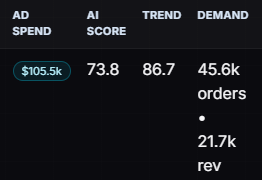
Worked example
A campaign with good CTR but weak contribution margin should be fixed before budget increases.
| Signal | Example read | Operator takeaway |
|---|---|---|
| Creative health | No severe fatigue | Scaling tired creative multiplies waste. |
| CPA stability | Within margin model | Revenue without profit is not scale. |
| Page support | Offer and proof aligned | Post-click weakness ruins ad gains. |
| Increase rule | Controlled increments | Avoid doubling into noisy data. |
Why Most Dropshippers Fail at Scaling (and How You Will Succeed)
The Scaling Trap That Kills Profitable Campaigns
You found a winner. Your $50/day campaign is generating $150/day in sales with a 3x ROAS. You think: "If I just double the budget, I will double the profit!" So you bump it to $100/day. The next morning, your ROAS has dropped to 1.2x and you are losing money. What happened?
Scaling Facebook ads is not about turning a dial. It is about structured progression, creative refreshment, and respecting the algorithm's learning phase. In this guide, you will learn the exact protocols used by established dropshipping brands to scale from $50/day to $5,000/day without destroying their performance.
What Has Changed in 2026
What Used to Work (2020-2023)
- Duplicating ad sets and increasing budget aggressively
- Relying on detailed interest targeting
- Running the same creative for months
- Scaling vertically by doubling budgets overnight
- Ignoring creative fatigue signals
What Works Now (2026)
- Horizontal scaling with Advantage+ campaigns
- Broad targeting with creative-driven audience segmentation
- Systematic creative refresh cycles every 7-14 days
- Vertical scaling in 20-30% increments every 2-3 days
- Monitoring ad fatigue with Scrape ad intelligence
The Scaling Foundations: What You Must Have Before Scaling
Do Not Scale a Campaign That Is Not Ready to Scale
Scaling amplifies everything—including problems. Before you increase a single dollar of budget, your campaign must meet these minimum thresholds. Skip this step and you will scale your way into losses.
The Scaling Readiness Checklist
- Stable ROAS for 7+ consecutive days: Your campaign should hit your target ROAS (2x minimum) every day for a full week. A single profitable day is luck. A profitable week is a trend.
- At least 50 purchase events: Facebook algorithm needs 50 conversions per week to properly optimize. If you are not hitting that, your campaign is still in learning phase and scaling will reset it.
- 3-5 backup creatives ready: You must have fresh ad creatives pre-made and ready to launch. Scaling increases ad fatigue speed. Without backup creatives, you will scale into a wall.
- Profit margin above 30%: If your net margin is less than 30%, scaling will squeeze you. Ad costs fluctuate. You need buffer room for CPM spikes.
- Cash reserve for at least 3 days of ad spend: Never scale with money you cannot afford to lose. Have enough cash to cover the increased budget for 3 days even if sales lag.
Horizontal Scaling: The Safe First Step
Horizontal Scaling = More Campaigns, Not More Budget
Before you increase the budget on your winning campaign, duplicate its structure with fresh creatives and slightly different audiences. This spreads risk across multiple campaigns instead of concentrating it in one.
The 3x3 Horizontal Scaling Protocol
- Take your winning campaign structure (the ad set settings, targeting, and optimization event that worked).
- Create 3 new campaigns with the same structure but new creative variations. Each campaign should have 3 ad creatives.
- Launch all 3 campaigns at the same budget as your original winner (e.g., $50/day each).
- After 3 days, kill the bottom 2 performers and keep the best one alongside your original winner.
- Repeat this process weekly to constantly refresh your creative pipeline and audience saturation.
This approach increases your total spend from $50/day to $200/day across 4 campaigns, but spreads the risk. If one campaign fatigues, you still have 3 others generating revenue.
Vertical Scaling: How to Increase Budget Without Killing Performance
The 20-30% Rule: The Only Safe Way to Scale Budget
Vertical scaling means increasing the budget on an existing campaign. The golden rule: never increase more than 20-30% every 2-3 days. Anything more resets the learning phase and triggers re-optimization, which temporarily kills performance.
Example Vertical Scaling Schedule
- Day 1-3: Campaign running at $50/day, stable ROAS above 2x.
- Day 4: Increase budget to $65/day (30% increase). Monitor ROAS.
- Day 5-6: If ROAS holds above 2x, increase to $85/day on Day 6.
- Day 7-8: If ROAS stays stable, increase to $110/day on Day 8.
- Continue 20-30% increases every 48-72 hours as long as ROAS remains above your target.
- If ROAS drops below target: Pause the increase. Wait 2 days. If it recovers, resume scaling. If not, scale back down.
When to Stop Vertical Scaling
Every campaign has a ceiling. That ceiling is determined by audience size, creative fatigue, and market competition. Signs you have hit the ceiling:
- CPM increases by 50%+ after a budget increase
- ROAS drops and does not recover after 48 hours
- Frequency (impressions per user) exceeds 2.0
- CTR drops below 1% on previously winning creatives
When you hit the ceiling, stop vertical scaling and switch to horizontal scaling with fresh creatives.
Campaign Structures That Scale Past $1,000/Day
The Right Campaign Structure Prevents Scaling Headaches
Most dropshippers use a single CBO (Campaign Budget Optimization) campaign and try to scale it to the moon. That works until it does not. Here are the campaign structures that established stores use to scale sustainably.
Structure 1: The Testing Machine (Under $500/day Total Spend)
- Campaign A (Testing): 1 ABO campaign with 3-5 ad sets, each containing 2-3 creatives. Budget: $50-100/day. Purpose: constantly testing new creatives and audiences.
- Campaign B (Scaling): 1 CBO campaign containing only proven ad sets from Campaign A. Budget: whatever you are scaling. Purpose: running winners at higher spend.
- Campaign C (Retargeting): 1 campaign targeting video viewers, page visitors, and add-to-carts. Budget: 10-15% of total spend.
Structure 2: The Portfolio Approach ($500-5,000/day Total Spend)
- Multiple CBO campaigns each targeting a different product or product category.
- Each campaign contains 3-5 ad sets with 2-3 creatives each (proven from testing).
- Horizontal scaling by launching new CBO campaigns for new products while maintaining existing winners.
- Vertical scaling within each CBO by increasing the campaign budget 20-30% every 2-3 days.
- Advantage+ Shopping Campaigns: For stores with 100+ purchases, Meta's AI-driven campaigns can be powerful. Feed them your best creatives and let the algorithm optimize.
Creative Refresh: The Secret to Long-Term Scaling
Your Creative Is a Battery—It Drains Over Time
Every ad creative has a lifespan. The average winning creative lasts 14-21 days before performance degrades significantly. Scaling accelerates this decay because more budget means more impressions, faster frequency, and quicker audience fatigue.
The solution is not to wait until performance dies—it is to pre-emptively refresh your creatives on a schedule.
The 7-Day Creative Refresh Cycle
- Day 1-7: Your winning creative is performing. You are scaling vertically.
- Day 5: Begin preparing 2-3 new creative variations (different hooks, same proven angle).
- Day 7: Launch new creatives in a separate testing campaign (do not touch your winner).
- Day 7-10: If a new creative outperforms your existing winner, swap it into your scaling campaign.
- Day 10-14: Your original creative starts to fatigue. Your replacement is already running and scaling.
Use Scrape to Eliminate Creative Guesswork
Instead of guessing what new creatives to test, use Scrape ad intelligence to see what competitors in your niche are running. Filter by ad duration (30+ days = proven winners) and model your new creatives on the hooks and angles that are already validated. This turns creative refresh from a guessing game into a data-driven process.
How to Scale Without Getting Your Ad Account Banned
Scaling Attracts Scrutiny—Be Ready for It
When you suddenly start spending $500/day instead of $50/day, Facebook's automated systems notice. If your account looks suspicious (new, unverified, high dispute rate), scaling will trigger a review. Here is how to stay clean.
The Scaling Safety Checklist
- Verify your Business Manager: Complete all verification steps (business info, payment method, identity confirmation) before you start scaling.
- Warm up new payment methods: If you add a new credit card with a high limit, make small charges first before running $500/day.
- Keep your Page Quality Score green: Monitor your Facebook Page Quality tab weekly. Delete any ads with high negative feedback immediately.
- Dispute rate under 1%: Chargebacks kill ad accounts. Offer refunds proactively. A $20 refund costs less than a banned ad account.
- Compliant landing pages: Your store must have clear contact info, shipping times, refund policy, and privacy policy. Facebook crawls your landing pages before approving higher budgets.
- Gradual scaling pattern: Accounts that spend $50/day for weeks then suddenly spend $500/day look like fraud. Use the 20-30% incremental increases described above.
The Metrics That Actually Matter When Scaling
Most Dropshippers Track the Wrong Numbers
When scaling, ROAS is not the only metric that matters. CPM, frequency, and CTR tell you whether your scaling is sustainable or about to crash. Here is what to watch.
The 4 Scaling Health Metrics
1. CPM Stability
What it tells you: Whether the auction is getting more expensive (audience saturation).
Healthy: CPM increases slowly (10-20% per week) as you scale. This is normal.
Warning: CPM doubles suddenly after a budget increase. Your audience is saturated.
Action: Pause scaling. Launch fresh creatives to new audiences.
2. Frequency
What it tells you: How many times the average person has seen your ad.
Healthy: Under 1.5 for cold audiences.
Warning: Above 2.0. Your audience is seeing your ad too often and developing banner blindness.
Action: Refresh creatives immediately. Frequency above 2.0 usually kills ROAS within days.
3. CTR Trend
What it tells you: Whether your creative is still resonating.
Healthy: CTR above 1% and stable or slowly declining.
Warning: CTR drops below 1% or declines 30%+ in a week.
Action: Your creative is fatiguing. Launch replacement creatives immediately.
4. CPA Trend
What it tells you: Whether your scaling is still profitable.
Healthy: CPA increases slowly (10-20% per week) but stays below your target.
Warning: CPA spikes 50%+ after a budget increase and does not recover.
Action: Scale back down to the budget where CPA was stable. You scaled too fast.
How Scrape Makes Scaling Easier and Safer
Data-Driven Scaling Is the Only Safe Scaling
Guessing when to scale, when to refresh creatives, and when to pull back is how you lose money. Scrape gives you the competitive intelligence to make scaling decisions with confidence.
What Scrape Tells You That Facebook Does Not
- Competitor scaling signals: See when competitors are increasing their ad spend—a sign the market is growing and you should scale too.
- Creative fatigue benchmarks: Know how long competitor creatives last in your niche so you can refresh pre-emptively.
- New audience opportunities: Discover which platforms and audiences competitors are expanding into.
- Product saturation alerts: Know when too many stores enter your niche so you can diversify before your main product saturates.
The Scaling Advantage: The dropshippers who scale fastest are not the ones with the biggest budgets. They are the ones with the best information. Scrape gives you the same intelligence that established operators use to make scaling decisions. The preview lets you inspect the ranked feed before choosing a plan.
Scaling Questions Real Dropshippers Ask
How fast can I realistically scale a winning Facebook ad campaign?
Realistically, from $50/day to $500/day takes 2-4 weeks with consistent performance. From $500/day to $5,000/day takes an additional 4-8 weeks. Anyone promising you can go from $50 to $5,000 in a week is either lying or lucky (and luck runs out). The 20-30% every 2-3 days rule works. Follow it and you will reach your goals without blowing up your account.
Should I use CBO or ABO for scaling?
Use CBO (Campaign Budget Optimization) for scaling campaigns where you trust Facebook to allocate budget efficiently across ad sets. Use ABO (Ad Set Budget Optimization) for testing campaigns where you want to control exactly how much each ad set spends. For most dropshippers: test with ABO, scale with CBO. Advantage+ Shopping Campaigns are also worth testing once you have 100+ purchase events per week.
What do I do if my ROAS drops after scaling up?
First, do not panic and slash your budget to zero. That often makes things worse. Instead: 1) Wait 48 hours. The algorithm sometimes needs time to adjust to the new budget. 2) If ROAS is still below target after 48 hours, reduce your budget back to the last level where it was profitable. 3) Launch new creatives in a separate testing campaign. 4) Once a new creative proves itself, try scaling again. Most scaling drops are temporary and recover within 2 days.
How many ad creatives do I need when scaling past $1,000/day?
At $1,000/day, you should have 6-9 active ad creatives across your campaigns, with 3-5 more in testing. Creative fatigue accelerates at higher budgets. A creative that lasts 3 weeks at $100/day might fatigue in 5 days at $1,000/day because of the vastly higher impression volume. Use Scrape to monitor competitor creative refresh rates in your niche and match their pace.
Is it better to scale one product to $5,000/day or multiple products to $1,000/day?
Multiple products to $1,000/day each is significantly safer and more sustainable. A single product at $5,000/day is fragile. If that product saturates, gets copied, or faces a supplier issue, your entire business is at risk. Diversify across 3-5 products in related niches. If one product declines, the others keep your business running while you find a replacement.
Direct answer
Facebook Ads Scaling for Dropshipping From 50 to 5 000 Day Scrape University is useful for dropshipping when it helps a beginner make a safer product, supplier, traffic, or store decision.
- Who it helps: dropshippers deciding what to test with ad spend.
- Decision it supports: whether an angle, creative, product, or campaign deserves more budget.
- Metrics to check: hook rate, CTR, CPC, CPA, creative fatigue, comment sentiment, and contribution margin.
Facebook Ads Scaling for Dropshipping From 50 to 5 000 Day Scrape University for beginners
Plain-English definition
Facebook Ads Scaling for Dropshipping From 50 to 5 000 Day Scrape University is a way to make a clearer dropshipping decision before you spend money on products, suppliers, ads, or store changes.
For a beginner, the goal is simple: understand what the signal means, check whether it fits your store, and avoid acting on hype before the numbers and execution path make sense. A beginner testing a skincare product should compare hook rate, click cost, add-to-cart rate, offer clarity, and comment quality before raising spend.
Beginner steps
- Start by writing the exact decision you want Facebook Ads Scaling for Dropshipping From 50 to 5 000 Day Scrape University to help with.
- Check demand, margin, competition, supplier reliability, and customer trust before you launch.
- Choose one next action: test, improve, monitor, or reject the opportunity.
Beginner mistakes to avoid
- Copying a product just because another store appears to be selling it.
- Ignoring shipping, refund, support, and ad learning costs.
- Reading strategy content without turning it into a specific next step.
Facebook Ads Scaling for Dropshipping From 50 to 5 000 Day Scrape University evidence checklist
This section makes the page more useful than a generic facebook ads scaling for dropshipping from 50 to 5 000 day scrape university article. Use it to separate real operating evidence from keyword-level advice.
What to check
- Use the guide to define the topic, then move into examples and action thresholds.
- Check whether the advice applies to your product type, supplier model, and traffic channel.
- Finish with one decision rather than more reading.
Authority signals to build
- Primary proof: hook rate, CTR, CPC, CPA, creative fatigue, comment sentiment, and contribution margin.
- Authority asset to add over time: creative teardown examples, ad-account diagnostics, and campaign review workflows.
- Internal proof: link this page to related product research, supplier, ad, and store optimization pages.
Decision system for operators
Use this section when the page starts influencing real product research, supplier selection, ad testing, store positioning, or channel expansion. The goal is to protect judgment while still moving quickly.
What to verify before acting
- The page's core claim matches live product, competitor, supplier, or channel evidence.
- The economics still work after fees, refunds, shipping, support, and ad learning costs.
- The decision is clear: whether an angle, creative, product, or campaign deserves more budget.
- The team can execute the next step this week without creating hidden operational debt.
What to ignore
- One-off viral examples with no repeatable buyer problem.
- Supplier promises that do not match delivery, tracking, packaging, or return reality.
- Metrics that look exciting but do not change a launch, pricing, or scaling decision.
What Scrape adds
- Live product and market context so research is connected to movement, not stale lists.
- Competitor and ad intelligence that helps separate real demand from surface-level noise.
- A repeatable way to review hook rate, CTR, CPC, CPA, creative fatigue, comment sentiment, and contribution margin.
- A single workspace for turning article-level strategy into an accountable operating queue.
Facebook Ads Scaling Guide for Dropshipping 2026: From $50 to $5,000/Day | Scrape University workflow
Use this workflow to turn the page into a practical decision process.
Review the market signal
Validate the main claim against live market conditions and your current store context.
Compare constraints and upside
Pressure-test the option across margin, execution difficulty, operational risk, and speed to value.
Convert insight into action
Leave the page with one clear next decision instead of passive research.
Facebook Ads Scaling Guide for Dropshipping 2026: From $50 to $5,000/Day | Scrape University scorecard
Use this scorecard to judge whether the recommendation is strong enough to act on.
| Dimension | What to check | Why it matters |
|---|---|---|
| Signal quality | Does this page identify a real decision or measurable tradeoff? | Keeps shallow content from driving store decisions. |
| Execution fit | Can your current store, supplier setup, and traffic channel support the recommendation? | Aligns strategy with operational reality. |
| Commercial upside | Would acting on this improve speed, margin, conversion, or decision quality? | Makes the page useful beyond education. |
Frequently asked questions
What is the main takeaway from Facebook Ads Scaling Guide for Dropshipping 2026: From $50 to $5,000/Day | Scrape University?
The complete guide to scaling Facebook ads for your Shopify dropshipping store. Learn the exact scaling protocols, budget increases, creative refresh schedules, and campaign structures used by established brands. Updated for 2026.
How should this page be used?
Use it as an operating reference, then compare the guidance against live data inside Scrape.
Put the research into practice.
Turn the checklist on this page into a live decision inside Scrape. Inspect demand, margin, saturation, supplier risk, and ad activity in one workspace.