
Niche Saturation Scorecard: Finding Your 2026 Edge
Benchmark your niche against the 2026 market. Score your category on keyword difficulty, competitor density, and profit viability.
Benchmark your niche against the 2026 market. Score your category on keyword difficulty, competitor density, and profit viability.
Benchmark your niche against the 2026 market. Score your category on keyword difficulty, competitor density, and profit viability.
Product research example
Use this page to move from broad interest to a product decision. The strongest ideas have demand, margin, supply, and creative angles.
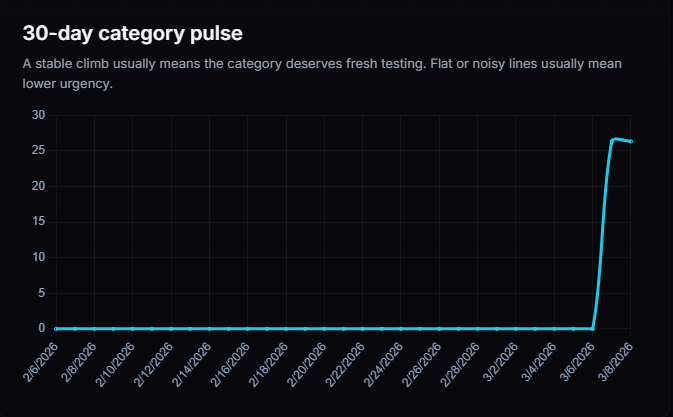
Worked example
A product should be rejected if the only evidence is one viral example with no margin or supplier validation.
| Signal | Example read | Operator takeaway |
|---|---|---|
| Demand | Look for repeated signal | One viral post is not enough. |
| Margin | Model landed cost | Profit must survive ads and refunds. |
| Competition | Check saturation | Too many clones lower upside. |
Competitive Density
Is your niche 'Red Ocean' (price wars) or 'Blue Ocean' (new user cases)? Score your category on its resilience against Amazon Basics' entry.
Direct answer
A Niche Saturation Finding Your Edge scorecard is strongest when it forces a clear decision: launch, improve, monitor, or reject.
- Who it helps: beginners trying to choose a product without copying random viral lists.
- Decision it supports: whether a product has enough demand, margin, and execution fit to test.
- Metrics to check: demand persistence, competitor count, supplier depth, gross margin, review velocity, and angle repeatability.
Niche Saturation Finding Your Edge for beginners
Plain-English definition
Niche Saturation Finding Your Edge is a way to make a clearer dropshipping decision before you spend money on products, suppliers, ads, or store changes.
For a beginner, the goal is simple: understand what the signal means, check whether it fits your store, and avoid acting on hype before the numbers and execution path make sense. A beginner evaluating a pet grooming tool should compare buyer pain, repeat use, supplier depth, competitor saturation, margin after shipping, and ad-angle variety.
Beginner steps
- Start by writing the exact decision you want Niche Saturation Finding Your Edge to help with.
- Check demand, margin, competition, supplier reliability, and customer trust before you launch.
- Choose one next action: test, improve, monitor, or reject the opportunity.
Beginner mistakes to avoid
- Copying a product just because another store appears to be selling it.
- Ignoring shipping, refund, support, and ad learning costs.
- Reading strategy content without turning it into a specific next step.
Niche Saturation Finding Your Edge evidence checklist
This section makes the page more useful than a generic niche saturation finding your edge article. Use it to separate real operating evidence from keyword-level advice.
What to check
- Score only criteria that change a decision.
- Use thresholds so the team knows what launch, monitor, improve, and reject mean.
- Update the scorecard after outcomes prove which criteria mattered.
Authority signals to build
- Primary proof: demand persistence, competitor count, supplier depth, gross margin, review velocity, and angle repeatability.
- Authority asset to add over time: live product examples, market screenshots, niche scorecards, and weekly product teardowns.
- Internal proof: link this page to related product research, supplier, ad, and store optimization pages.
Decision system for operators
Use this section when the page starts influencing real product research, supplier selection, ad testing, store positioning, or channel expansion. The goal is to protect judgment while still moving quickly.
What to verify before acting
- The page's core claim matches live product, competitor, supplier, or channel evidence.
- The economics still work after fees, refunds, shipping, support, and ad learning costs.
- The decision is clear: whether a product has enough demand, margin, and execution fit to test.
- The team can execute the next step this week without creating hidden operational debt.
What to ignore
- One-off viral examples with no repeatable buyer problem.
- Supplier promises that do not match delivery, tracking, packaging, or return reality.
- Metrics that look exciting but do not change a launch, pricing, or scaling decision.
What Scrape adds
- Live product and market context so research is connected to movement, not stale lists.
- Competitor and ad intelligence that helps separate real demand from surface-level noise.
- A repeatable way to review demand persistence, competitor count, supplier depth, gross margin, review velocity, and angle repeatability.
- A single workspace for turning article-level strategy into an accountable operating queue.
Niche Saturation Scorecard: Finding Your 2026 Edge workflow
Use this workflow to turn the page into a practical decision process.
Review the market signal
Validate the main claim against live market conditions and your current store context.
Compare constraints and upside
Pressure-test the option across margin, execution difficulty, operational risk, and speed to value.
Convert insight into action
Leave the page with one clear next decision instead of passive research.
Niche Saturation Scorecard: Finding Your 2026 Edge scorecard
Use this scorecard to judge whether the recommendation is strong enough to act on.
| Dimension | What to check | Why it matters |
|---|---|---|
| Signal quality | Does this page identify a real decision or measurable tradeoff? | Keeps shallow content from driving store decisions. |
| Execution fit | Can your current store, supplier setup, and traffic channel support the recommendation? | Aligns strategy with operational reality. |
| Commercial upside | Would acting on this improve speed, margin, conversion, or decision quality? | Makes the page useful beyond education. |
Frequently asked questions
What is the main takeaway from Niche Saturation Scorecard: Finding Your 2026 Edge?
Benchmark your niche against the 2026 market. Score your category on keyword difficulty, competitor density, and profit viability.
How should this page be used?
Use it as an operating reference, then compare the guidance against live data inside Scrape.
Put the research into practice.
Turn the checklist on this page into a live decision inside Scrape. Inspect demand, margin, saturation, supplier risk, and ad activity in one workspace.